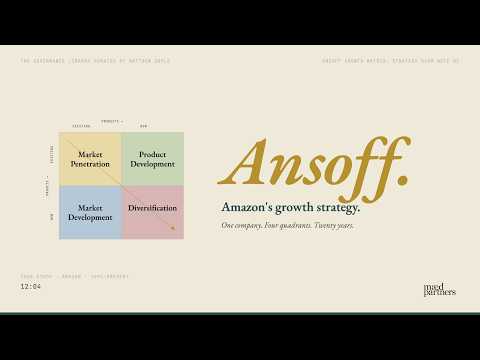
Case-study anchor: Amazon · Growth Strategy (1994 to present). Positive contrast: Microsoft · Satya Nadella era (2014 to present).
Three things to carry forward
- The four quadrants are four different risk categories, not four different sizes of the same risk. Market penetration tests execution and unit economics. Market development tests learning a new market with a known product. Product development tests building a new capability for a known customer. Diversification tests both unknowns at once and is the highest-risk quadrant by definition. A board that nods through a "growth strategy" without first naming its quadrant has skipped the question the framework was designed to surface.
- Risk is approved at a point in time. The board's obligation is to track the trajectory. Amazon's board did not approve "growth strategy 1994–2024" once. It made hundreds of decisions across two decades, each a step across the matrix. The risk approved in 2001 with the first AWS investment was still resolving in 2021 when Haven dissolved. A growth strategy is not an event at one point on the matrix, it is a trajectory across it, and the trajectory is what governance must follow.
- The framework's discipline shows itself most clearly in the closures. Microsoft's Bing, Cortana, and the Nokia handset write-down were not strategic embarrassments, each was a quadrant decision being reversed, publicly, by a board that knew which quadrant the original investment had occupied. Haven was not unusually ambitious, it was a diversification play in the highest-risk quadrant approved without a clear answer to the capability question. The same matrix produced both stories. The difference was whether anyone was using it.
A reading
Foundational text
- Ansoff, H.I. (1957) 'Strategies for Diversification', Harvard Business Review, 35(5), pp. 113–124. The definitional paper. Where the matrix was first set out. Short, canonical, and still the cleanest statement of why the four quadrants name four different risk categories.
- Ansoff, H.I. (1965) Corporate Strategy: An Analytic Approach to Business Policy for Growth and Expansion. New York: McGraw-Hill. The book in which Ansoff refined the matrix and introduced the term synergy, celebrated more often than the matrix that produced it.
Amazon · primary record
- Bezos, J. (1997) Letter to Shareholders. Filed with Amazon's first annual report after the IPO; reproduced annually in every subsequent shareholder letter. The governance constitution of the company. Long-term free cash flow as the held-against measure; not short-term profit.
- Amazon.com, Inc. (2018) 'Amazon to Acquire PillPack', press release, 28 June 2018. The publicly disclosed acquisition price was approximately $753 million. Read alongside the 2021 dissolution announcement of Haven for the contrast between a board-approved capability acquisition and a board-approved capability gap.
Microsoft · primary record
- Nadella, S. (2017) Hit Refresh: The Quest to Rediscover Microsoft's Soul and Imagine a Better Future for Everyone. New York: Harper Business. Written in the third year of Nadella's tenure. Sets out the strategic frame that has governed each subsequent capital allocation. Read for the Ansoff discipline rather than the management memoir.
- Microsoft Corporation, Annual Reports and Letters to Shareholders, 2014–2024. Available via the Microsoft Investor Relations site. Each year contains a public quadrant framing for the major allocations, LinkedIn (2016), GitHub (2018), Activision Blizzard (2023), and equally public explanations for the closures of Bing investment, Cortana, and the Nokia handset business.
A question
For each major capital allocation your board approved in the last twelve months, identify the Ansoff quadrant.
If you find more than one diversification play running simultaneously, ask whether the organisation has the governance bandwidth to track both. If the answer is uncertain, the question has already been answered.
The wider library
This Note treats growth strategy as a board governance instrument, not a marketing or planning exercise. Ansoff names what kind of risk a growth choice represents before any financial model is built around it. The Notes either side of it answer the questions Ansoff cannot.
This Note connects directly to:
- Strategy Room Note 08 (PESTLE Analysis · Post Office). PESTLE diagnoses the macro environment that any growth strategy must navigate. PESTLE asks what is changing outside the organisation; Ansoff asks what the organisation proposes to do in response. The two work together, PESTLE before approval, Ansoff at the approval gate.
- Strategy Room Note 09 (Freeman's Stakeholder Theory · BP). Freeman names whose interests a growth choice disturbs. A diversification play that the matrix correctly classifies as the highest-risk quadrant still requires a Freeman audit of which stakeholder groups have standing to oppose it.
- Strategy Room Note 10 (Mendelow's Stakeholder Matrix · BP). Mendelow refines Freeman by mapping the power and interest of each stakeholder group. A board that has identified the Ansoff quadrant has answered the strategy question; Mendelow then tells it which stakeholders have the power to make the strategy succeed or fail.
- Strategy Room Note 21 (Mintzberg's 5 Ps · BP). Mintzberg's meta-framework provides the analytical vocabulary. In Mintzberg's terms, Ansoff is a plan, a consciously intended course of action. The matrix does not, on its own, surface pattern (what the organisation actually does over time) or perspective (the mental model that governs decisions). Use Mintzberg to test whether the Ansoff plan is the strategy actually being run.
The Amazon case anchor (1994 to present) and the Microsoft positive contrast (2014 to present) are specific to this Note and do not extend into any other Library Note.